Potenciómetro y servomotor
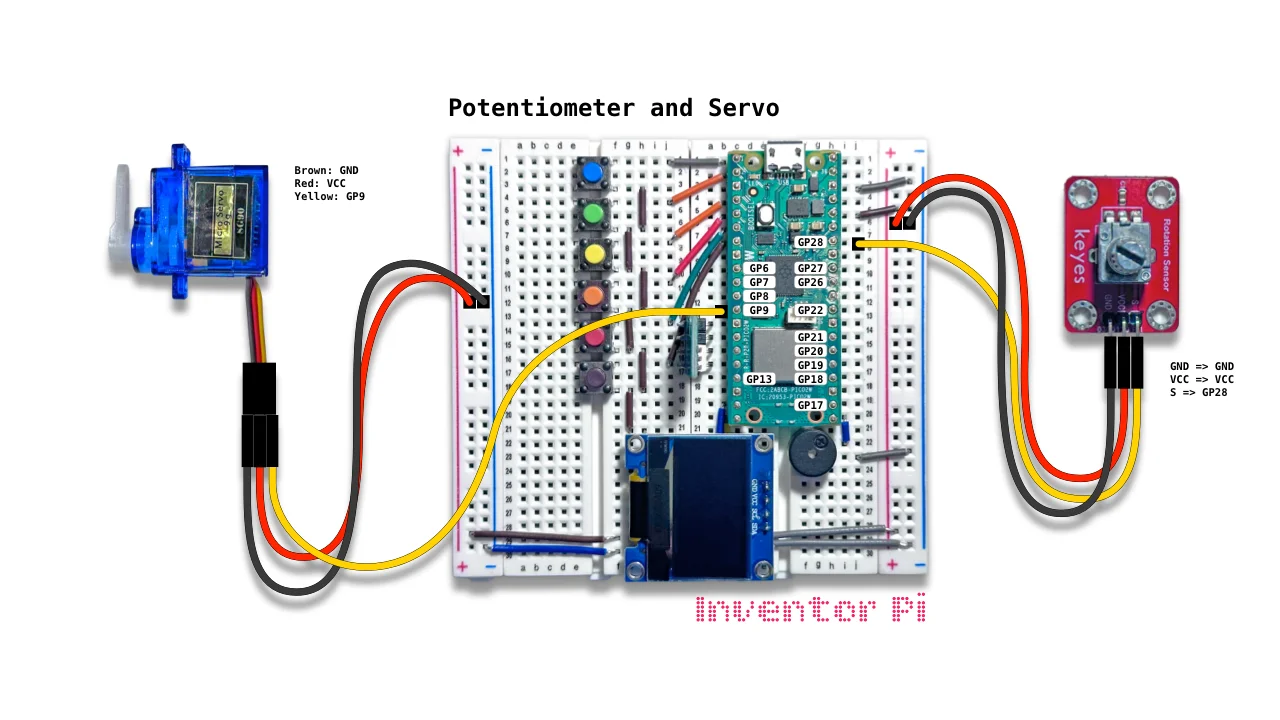
Un ejemplo de código MicroPython Funciona con un microcontrolador Raspberry Pi Pi Pico 2 W conectado a un micro servomotor, un módulo de potenciómetro (sensor de rotación) y un módulo de pantalla OLED (SSD1306) en una placa de prototipos controlar el ángulo del servo girando el potenciómetro y visualizarlo en la pantalla
Los potenciómetros son los diales que giramos para controlar cosas como la temperatura o el volumen. Funcionan variando la resistencia eléctrica, lo que interpretamos como una variación de voltaje en el pin de entrada de un microcontrolador. En este script, usamos esta entrada para controlar el ángulo de un servomotor.
Un servomotor es un motor en el que podemos controlar el ángulo de rotación cambiando la señal PWM que le enviamos. A diferencia de los motores eléctricos estándar que giran continuamente, un servomotor se mueve a un ángulo o posición exactos y lo mantiene firmemente.
Crea un nuevo archivo en Thonny con el nombre potentiometer_and_servo.py. Copia y pega el código que aparece a continuación en el archivo que creaste.
1
2
3
4
5
6
7
8
9
10
11
12
13
14
15
16
17
18
19
20
21
22
23
24
25
26
27
28
29
30
31
32
33
34
35
36
37
38
39
40
41
42
43
44
45
46
47
48
49
50
51
52
53
54
55
56
57
58
59
60

print("\nPotentiometer and Servo")

# DESCRIPTION

# Potentiometers are the dials we turn to control things like temperature or volume.
# They work by varying the electrical resistance, which we read as varying voltage at a
# microcontroller's input pin. In this script, we use this input to control a servo angle.

# A servo is a motor where we can control the rotation angle by changing the PWM
# signal we send to it. Unlike standard electric motors that spin continuously,
# a servo motor moves to an exact angle or position and holds it firmly.

# CONNECTIONS REQUIRED

# Connect Potentiometer module (labeled 'Rotation Sensor')
#   Pins: GND => GND, VCC => VCC, S => GP28
# Connect Servo
#   Pins: Brown: GND, Red: VCC, Yellow: GP9

from time import sleep
from machine import Pin, ADC
from oled import OLED
from rgbled import RGBLED
from value_filter import ValueFilter
from servo import Servo
from helper import interpolate

potentiometer = ADC(Pin(28))
oled = OLED(scl_pin=15, sda_pin=14)
rgbled = RGBLED(red_pin=12, green_pin=11, blue_pin=10)
value_filter = ValueFilter(filters=["Median", "EMA"], window_size=10, alpha=0.5)
servo = Servo(servo_pin=9)

sensor_max = 65535

try:
    while True:
        # Use Median filter to reduce noise
        # Use Exponential Moving Average filter to smooth out reading
        # giving priority to recent readings over older ones
        value = value_filter.update(potentiometer.read_u16())

        # Interpolate LED from purple to pink: red from 64 to 191 and blue from 191 to 64
        r = interpolate(value, 0, sensor_max, 64, 191)
        b = interpolate(value, 0, sensor_max, 191, 64)
        angle = interpolate(value, 0, sensor_max, 180, 0) # inverted out_min and out_max to match potentiometer rotation direction

        rgbled.set_color(r=r, b=b)
        servo.set_angle(angle)

        oled.print(f"Raw: {value:0.0f}", f"Angle: {angle}")
        sleep(0.005)

except KeyboardInterrupt:
    print("\nInterrupted by user!")

finally:
    oled.reset()
    rgbled.reset()
    servo.reset()