Sensor de movimiento
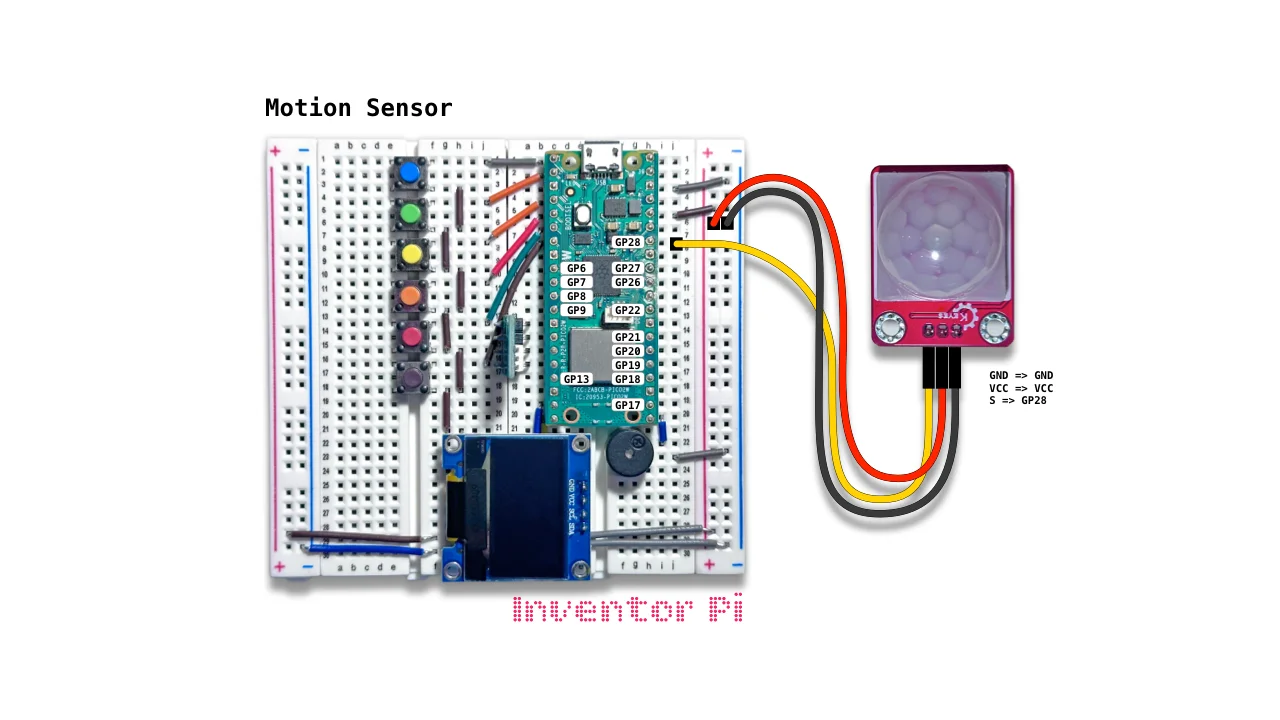
Un ejemplo de código MicroPython Funciona con un microcontrolador Raspberry Pi Pi Pico 2 W conectado a un módulo sensor de movimiento PIR, un módulo LED RGB y un módulo de pantalla OLED (SSD1306) en una placa de pruebas para cambiar el color del LED y mostrar el estado en la pantalla cuando se detecta movimiento
Un sensor de movimiento PIR detecta el movimiento midiendo los cambios en la radiación infrarroja (calor) emitida por los objetos circundantes. Cuando un cuerpo caliente (como un ser humano o un animal) se mueve a través del campo, intercepta primero una mitad del sensor y luego la otra, creando un pulso de voltaje diferencial que indica movimiento. Se utiliza en alarmas de seguridad y automatización del hogar inteligente.
Al ejecutar este script en un aula, cubra completamente el sensor con un libro o hojas de papel dobladas, luego espere a que el sensor se reinicie y muestre No motion. Luego, retira el libro y espera a que el sensor detecte movimiento.
Crea un nuevo archivo en Thonny con el nombre motion_sensor.py. Copia y pega el código que aparece a continuación en el archivo que creaste.
1
2
3
4
5
6
7
8
9
10
11
12
13
14
15
16
17
18
19
20
21
22
23
24
25
26
27
28
29
30
31
32
33
34
35
36
37
38
39
40
41
42
43
44
45
46
47
48
49
50
51

print("\nMotion Sensor")

# DESCRIPTION

# A PIR motion sensor detects movement by measuring changes in
# infrared (heat) radiation emitted by surrounding objects.
# When a warm body (like a human or animal) moves across the field,
# it intercepts one half of the sensor first and then the other,
# creating a differential voltage pulse that signals motion.
# It is used in security alarms and smart home automation.

# When running this script in a classroom, cover the sensor completely with
# a book or folded sheets of paper, then wait for sensor to reset and display
# "No motion". Then remove the book and wait for the sensor to detect motion.

# CONNECTIONS REQUIRED

# Connect PIR Motion Sensor (HC-SR501) module
#   Pins: GND => GND, VCC => VCC, S => GP28

from time import sleep
from machine import Pin
from oled import OLED
from rgbled import RGBLED

motion_sensor = Pin(28, Pin.IN)
oled = OLED(scl_pin=15, sda_pin=14)
rgbled = RGBLED(red_pin=12, green_pin=11, blue_pin=10)

try:
    while True:

        # When motion_sensor value is 1, motion is detected.
        # It resets to 0 after some time if no motion is detected.
        # Wait until value has settled and does not change for one
        # full second, to reduce sensor noise.
        if motion_sensor.value() == 1:
            oled.print("Motion detected")
            rgbled.set_color(r=255)
        else:
            oled.print("No motion")
            rgbled.set_color(g=255)

        sleep(0.1)

except KeyboardInterrupt:
    print("\nInterrupted by user!")

finally:
    oled.reset()
    rgbled.reset()